
Scenes From a Divided Subject, Interval, London, 2026
HEREAFTER, Swedenborg Society, London, 2025.
Eau Sauvage, Mackintosh Lane, London, 2022.
Crocodile Cradle, PEER, London, 2021
The Enigma of the Hour: 100 Year of Psychoanalytic Thoughts with Goshka Macuga, Freud Museum, London, 2019
Revolt of the Sage with Craig Burnett, Blain Southern, London, 2016
Dadadandy Boutique, ARTPROJX SPACE, London, 2008
Le Palais des Etoiles, Selfridges, London, 2007
Space is the Place, Ritter Zamett London, 2006
Spring Summer, Program, London, 2005
From A to B and Back Again, Galerie Chez Valentin, Paris, 2005
EXPO 21: Strategies of Display, Angel Row Gallery Nottingham touring to Mead Gallery Coventry, 2004
AFM, with John Armleder and Sylvie Fleury, Percy Miller, London, 2004
Simon Moretti featuring John Armleder, Galerie Chez Valentin, Paris 2003
Vis-a-Vis, Platform, 2003
The Green Room, Percy Miller Gallery, London, 2002

Simon Moretti: Scenes from a Divided Subject
featuring Paul Éluard, Pablo Picasso and Joel Wyllie.
“The I is always in the field of the other” - Jacques Lacan, Seminar XI, The Four Fundamental Concepts of Psychoanalysis (1964)
Scenes from a Divided Subject is an exhibition by Simon Moretti that engages with the writings and theories of French psychoanalyst Jacques Lacan, drawing in particular on his concept of the three orders: the Imaginary, the Symbolic, and the Real. For Lacan, these registers describe the fundamental dimensions of human experience. The Imaginary relates to images, identification, and misrecognition, how things appear to us and how we appear to ourselves. The Symbolic refers to the invisible structures that organise meaning: language, social rules, and shared systems of authority. The Real, by contrast, is not simply reality itself but what resists language and representation, something ungraspable that can only be encountered through its traces or disruptions.
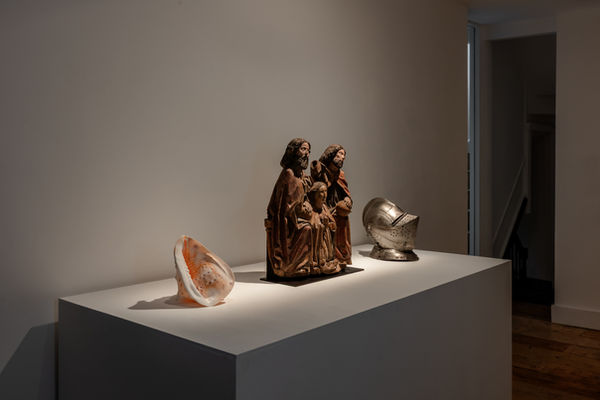
At the centre of the installation stands a large plinth on which three distinct objects are arranged in constellation, bringing image, power, and material presence into contact with one another. Rather than following the conventions of a traditional museum display, where objects are separated and assigned fixed meanings, this grouping presents them as a single sculptural work whose significance shifts through proximity and contrast, a site where connections are simultaneously proposed and unsettled.
The first object is a late Gothic carved wood sculpture depicting the Coronation of the Virgin c. 1500, a subject widely incorporated into Southern German altarpieces of the middle to late Gothic period. It represents the elevation of the earthly mother to her celestial and regal position, endowed with divine status and immortality. Although both scripture and Catholic doctrine are silent on the matter, the scene became one of the most celebrated themes of medieval devotion. The image stages a transformation, earthly body becoming heavenly sovereign, in which the question of recognition, of who confers identity and by whose authority, resonates directly with Lacan's account of the subject constituted through the gaze of the Other.
Beside it rests a queen helmet shell (Cassis madagascariensis), its form at once organic and architectural, a structure grown from within and coiled around an absence at its centre. The shell offers an image of the self as a kind of housing: a surface organised around a void, beautiful and functional, yet concealing nothing but the retreat of the living thing that once inhabited it.
The third object is a North German close helmet for field use, Brunswick c. 1560-70, a crested combat helmet whose elegantly tapered form belies its purpose. Designed to protect and to intimidate in equal measure, the morion is both armour and image, a face that presents nothing but an impenetrable surface to the world, speaking to the Lacanian notion of the mask and the function of the gaze.
Taken together, the three objects trace a loose arc across Lacan's three orders: the Coronation belonging to the Symbolic, a scene of investiture and identity conferred through ritual and language; the shell inhabiting the Imaginary, a mirroring surface that reflects the outline of a self without containing one; the morion touching the Real, mute and impenetrable, resisting interpretation while demanding to be confronted.
These objects are presented alongside Moretti's signature neons, together with two works that extend the exhibition's themes. The first is Grand Air (Les Yeux Fertiles) 1936, a collaborative Surrealist etching by Pablo Picasso and French poet Paul Éluard, taking as its starting point Éluard's poem of the same name. Both were friends of Lacan, and the three figures shared a milieu in which psychoanalytic and Surrealist ideas moved freely between them. The second is a drawing from Joel Wyllie's Shedding Pictures series, works built up over long periods in the sketchbook, revisited across months and sometimes years, with erasure forming a core part of their development. The accumulated marks and removals of these drawings speak directly to Lacanian ideas of memory as never simply a record but a site of continual revision: what is retained, what is lost, and what returns in altered form. Two cursive lowercase i neons flank the installation, their mirrored placement evoking the Lacanian split subject — an "I" that asserts itself yet never fully coincides with its own image or speech.
In the lower ground space, a looping video constructed from inverted archival footage of Lacan's lectures extends these concerns into time and language. With image and audio reversed, speech becomes unreadable while subtitles remain intact, placing the viewer in the gap between sense and opacity. Across sculpture, light, and moving image, the exhibition foregrounds dislocation, fragmentation, and the unstable processes through which subjectivity is formed.
Simon Moretti is an artist based in London. His work deals with psychoanalytical and philosophical concepts through context and display, the use of appropriated images, archives, curatorial and publishing projects. Exhibitions include: Hereafter, The Swedenborg Society, London (2025), Eau Sauvage, Mackintosh Lane, London (2022); Crocodile Cradle, PEER, London (2021); None of the Above, a project by John Armleder, Kanal-Centre Pompidou, Brussels (2020); The Enigma of the Hour, with Goshka Macuga, Freud Museum, London (2019); A Utopian Stage: To Be Free is to Lose Sight of the Shore, curated by Vali Mahlouji, Dhaka Art Summit 18, Bangladesh (2018); Revolt of the Sage, with Craig Burnett, Blain Southern, London (2017); The Camera Exposed, works from the collection, Victoria & Albert Museum, London (2016); and Les Palais des Étoiles, Dadadandy at Selfridges, London (2007).
Special thanks to Mullany Haute Epoque Fine Art and Sims Reed London.
https://www.interval-clerkenwell.art/scenes-from-a-divided-subject
Simon Moretti
Scenes from a Divided Subject, 2026
- Queen Helmet seashell (Cassis madagascariensis)
- Coronation of the Virgin Limewood, with original polychrome and traces of gilding, Southern Germany, Swabia, c. 1500
- A north German close helmet for field use, Brunswick circa 1560-70

Simon Moretti
Scenes from a Divided Subject
(The Fertile i), 2026
Neon, cables, transformer
30 x 12 cm

Pablo Picasso and Paul Éluard
Grand Air. (Les Yeux Fertiles), 1936
Monochrome etching, AP
sheet size: 50.9 x 33.2 cm
plate size: 41.6 x 31.6 cm


Simon Moretti
Scenes from a Divided Subject, (When
They Already Have an Answer), 2026
Video, looped
variable dimensions

Joel Wyllie
Shedding Picture no. 7, 2024.
Pencil on paper
35.5 x 27 cm

HEREAFTER
THE SWEDENBORG SOCIETY, LONDON
17/01/25-30/05/25
SIMON MORETTI
WITH EILEEN AGAR | PAUL BECKER | WILLIAM BLAKE | ITHELL COLQUHOUN | HARIS EPAMINONDA | PAUL HEBER-PERCY | DONNA HUDDLESTON | DEREK JARMAN | LINDER | GOSHKA MACUGA | DAVID NOONAN | BEN RIVERS (screening 17 April) | DANIEL SILVER | MICHAEL E. SMITH | PELLE SWEDLUND | JOËLLE TUERLINCKX | GEORGE FREDERIC WATTS | JAMES JOHN GARTH WILKINSON | AND ITEMS FROM THE SWEDENBORG COLLECTION
In exploring the enigmatic and mercurial figure of Emanuel Swedenborg (1688–1772) through a range of themes, including correspondences, symbols, analogies, duality, transformation, the realms of heaven and hell, cosmology, divine truth and angelic conversations, the exhibition will examine the longstanding connections between art and esotericism. Diagrammatic works, which suggest or taxonomize symbolism, are one interface used to encounter the hereafter featured in the exhibition.
The installation will showcase new works by Moretti, alongside a diverse selection of works by guest artists. The exhibition will also include items from the Swedenborg House collection, including proto-surrealist drawings by James John Garth Wilkinson (1812–1899).
A programme of events to accompany Hereafter, including talks and screenings, will be announced in due course via the Swedenborg Society’s website and social media channels.
The exhibition will be accompanied by a book published by Swedenborg House and edited by Simon Moretti, featuring a selection of writers who will explore Swedenborgian themes through essays, prose and poetry. The commissioned writers include Chloe Aridjis, Jennifer Higgie and Deborah Levy. These responses will be presented alongside the works of previous Romantic and Symbolist poets who were directly influenced by Swedenborg such as Charles Baudelaire, William Blake, Jorge Luis Borges, Johann Wolfgang von Goethe, Stéphane Mallarmé and Edgar Allan Poe, as well as others such as Ithell Colquhoun, John Donne, Derek Jarman, Wallace Stevens and Tristan Tzara. The book will also feature a new poem written by Andrew Durbin plus images of the artists’ works and objects from the Swedenborg House collection as part of a visual essay designed by Moretti.
With thanks to Chloe Aridjis, Sylvia Kouvali, Frith Street Gallery, Large Glass, Kate MacGarry, Modern Art, Richard Shillitoe, Mattias Vendelmans and Amanda Wilkinson.
Photo Robert Glowacki

Double Vortext (after Emanuel Swedenborg) 2025
Neon, transformer, cables
79 x 59 cm


Vortex Becoming (after Emanuel Swedenborg) 2025
Neon, transformer, cables
52 x 104 cm

EAU SAUVAGE
Simon Moretti
Mackintosh Lane
12 Mackintosh Lane
London E9 6AE
17-18 September 2022
Inspired by the transitory and experimental nature of Mackintosh Lane and its multiple identities as an artist studio, a non-profit gallery, occasional pied-a-terre and photographic studio, Simon Moretti presents new and existing works that aim to create a complex symbolic narrative as a part of an overall gesamtkunstwerk. This enigmatic display engages with issues of agency, temporality, automatism, desire and masculinity as well as continuing his ongoing investigation with 'curating as practice’. The exhibition will feature new works made with found and borrowed objects, a sculpture made with a well known iconic male fragrance, a new neon text an existing collage and photographic work.
With thanks to Michael Anastassiades, Anna Higgins, Paul Heber-Percy, Goshka Macuga, David Noonan, Polys Peslikas.
Photo Robert Glowacki


blistering dawn
a reddish young orange speed
above the metal
(after Fabio Taglioni)
2020
Ducati Sport I 1000 Momposto motorbike (2006), purple Phalaenopsis orchid, glass vase
variable dimensions
Courtesy the artist and David Noonan

I am the river
attached to a rope
2022
Shiva Lingam stone
10 x 20 cm
Courtesy the artist and Michael Anastassiades
Shiva Lingam is a crypto-crystalline member of the Quartz family. This stone is found in only one of seven sacred Indian rivers. Villagers visit the Narmada River in Onkar Mandhata and polish these river rocks to better define their famed lingam shape. In Hindu culture, the lingam is a representation of the Lord Shiva in Shivaism and is believed to be a representation of their phallus
The Lingam represents the Brahmanda, which means “cosmic egg”, symbolising the creation of both the divine male and female energies.

Untitled (Intertext), 2012
Collage
44.5 x 44.5 cm


the summer grasses
are a relic of
the warriors’ dream
2021
Plaster head by Goshka Macuga
Courtesy the artist and Goshka Macuga

Untitled (Je est un autre un multiple toujours) 2014
silver gelatin print
50 x 40 cm, framed
We can firm up our identity, she suggests—but it will only ever be a mold, or a mask. Deeply influenced by Rimbaud, who declared that “Je est un autre” (”I is another”), Claude Cahun replies, “Je est un autre—un multiple toujours”—”I is another—and always multiple.”
Dirk Snauwar


early fountain
where the butterfly fly
under the skin
(after Edmond Roudnitska)
2022
Eau Sauvage, eau de parfume, Christian Dior, Paris
variable dimensions


Jupiter ascending
as tomorrow youth becomes
beyond the future
2022
Hyena Mask, Bamana, carved wood
Mali, 19th century
45 x 15 cm
Collection of the artist
Such masks were used during the Kore initiation, which ensured proper behaviour and social mores and the development of male identity. During their exhibition, the wearers of this mask most often adopt a bent position, supporting themselves on two short sticks that extend their forearms. The symbolism of the hyena, very complex, varies considerably according to the context, but within the framework of the Kore society the hyena most probably represents the initiates’ efforts to perfect their secret knowledge
Jean-Paul Colleyn
Bamana: The Art of Existence in Mali, New York, 2001, p. 98

entr’acte
2022
neon, transformer, cables
18 x 60 cm
noun, plural en·tr'actes [ahn-trakts, ahn-trakts; French ahn-trakt]. the interval between two consecutive acts of a theatrical or operatic performance. a performance, as of music or dancing, given during such an interval.

glowing day
a free light present rises
above the future
2022
Folded newspapers, sheep skull
25 x 30 x 40 cm

CROCODILE CRADLE
Simon Moretti
20 February – 18 April 2021
PEER is delighted to present Crocodile Cradle, a new exhibition on three platforms: a filmed performance online, accessible via a QR code; a text collage on the gallery's glass façade; and a book, to be published this summer. For this collaborative project, artist Simon Moretti invited 51 artists including Fiona Banner aka The Vanity Press, Tacita Dean, Liam Gillick, Lubaina Himid, Christian Marclay and Cerith Wyn Evans to supply a text that they have written or found.
The artists' texts have been brought to life with a reading by actor Alastair Mackenzie; a 38-minute-film of his one-take performance will be viewable on smartphones via a QR code, accessible from the gallery windows and online. A live performance and publication will follow later in the year.
Artists, in order of appearance are: Liam Gillick | Lubaina Himid | Helen Cammock | Matilde Cerruti Quara | Nedko Solakov | Jimmie Durham | Tacita Dean | Andrea Bowers | Erica Baum | Liliana Moro | Giorgio Sadotti | Dan Perjovschi | Alejandro Cesarco | Stefan Brüggemann | Fiona Banner aka The Vanity Press | David Horvitz | John Smith | David Austen | Cally Spooner | Vedovamazzei | Sue Tompkins | Peter Liversidge | Pavel Büchler | Cerith Wyn Evans | Goshka Macuga | Amikam Toren | Ruth Wolf-Rehfeldt | Ian Whittlesea | Sylvie Fleury |Ugo Rondinone | Christian Marclay | Simon English | Carey Young | Mai-Thu Perret |Jimmy Robert | Marysia Lewandowska | Nicholas Alvis Vega | Linder | Koushna Navabi | Sophie Jung | Karl Holmqvist | John Armleder | Annie Ratti | Jason Dodge | Cesare Pietroiusti | Marcel van Eeden | Daniel Gustav Cramer | Paul Heber-Percy | Joan Jonas | Jirí Kovanda | Ruth Wolf-Rehfeldt | Jonathan Monk
Some of the artists have contributed original texts, while others have selected excerpts by writers and poets such as Daniel Defoe, Andrew Marvel, Samuel Coleridge, Emily Dickinson, John Cage and Christopher Isherwood.


The Enigma of the Hour: 100 Year of Psychoanalytic Thoughts with Goshka Macuga
June-August 2019
An exhibition marking the centenary of The International Journal of Psychoanalysis.
This exhibition presents archival material touching on the origins and life of The International Journal alongside contemporary artworks, bringing together themes central to both psychoanalysis and art: translation, transformation, temporality, the unconscious, metaphor and dreams. The artworks address these ideas, creating a conversation that reverberates throughout the evocative rooms of the Freud Museum.
The archival presentation explores the prehistory of the journal, the hidden role of women in its early years, its beginnings and connections with the Bloomsbury Group, and the influence of classical art and culture on Freud’s ideas and the visual identity of the International Journal.
Courtesy Sadie Coles HQ
The exhibition includes new commissions by Simon Moretti and Goshka Macuga, alongside specially selected works by invited artists, Linder, Daniel Silver and Paloma Varga Weisz. Loans from the British Psychoanalytic Society, Tate and The Wellcome Trust including works by Duncan Grant, Barbara Ker-Seymer with John Banting and Rodrigo Moynihan, along with items from the Freud Museum Collection.
Photo Angus Mill


Revolt of the Sage with Craig Burnett, Blain Southern, London
Novembre 2016-January 2017
Revolt of the Sage is an exhibition featuring sixteen artists that takes its title from a work by Giorgio de Chirico painted in 1916. The Revolt of the Sage1 is an example of what the artist would call a ‘metaphysical interior’, and yet its crowded pictorial space overflows with ephemeral things:
frames, measuring devices and biscuits. Objects pile up and overlap, while a strange perspective recedes into an irresolvable background. What did the artist mean by a ‘metaphysical interior’? In a letter to Apollinaire, written around the time he painted The Revolt of the Sage, de Chirico describes two realms: our finite condition, and its loss and longing, and a metaphysical realm where time does not exist.
"It has been almost two years now since I’ve seen you. The Ephesian teaches us that time does not exist and that on the great curve of eternity the past is the same as the future. This might be what the Romans meant with their image of Janus, the god with two faces; and every night in dream, in the deepest hours of rest, the past and future appear to us as equal, memory blends with prophecy in a mysterious union.
Giorgio de Chirico to Apollinaire, July 1916
Picking up on de Chirico’s vision of a ‘metaphysical interior’, Revolt of the Sage gathers a range of artists who use collage, juxtaposition, fragments, framing devices and layered imagery to explore ruptures in time and the alluring mysteries of the everyday. The exhibition features new and existing work by contemporary"
Horst Ademeit, Lynn Chadwick, Hanne Darboven, Haris Epaminonda, Geoffrey Farmer, Jannis Kounellis, Mark Lewis, Goshka Macuga, Christian Marclay, Simon Moretti, David Noonan
Sigmar Polke, Erin Shirreff, Michael Simpson, John Stezaker, Paloma Varga Weisz
Photo Todd White


Simon Moretti
Untitled (Janus)
2016
Screen print
162.4 x 132.5 cm

Simon Moretti
Untitled (Standing Figure with Quartz)
2014
Screen print
162.4 x 132.5 cm


Simon Moretti
Untitled (Flash Gordon Kabbalah)
2014
Screen print
162.4 x 132.5 cm


Simon Moretti
Untitled (Boy Runner)
2016
Screen print
162.4 x 132.5 cm

